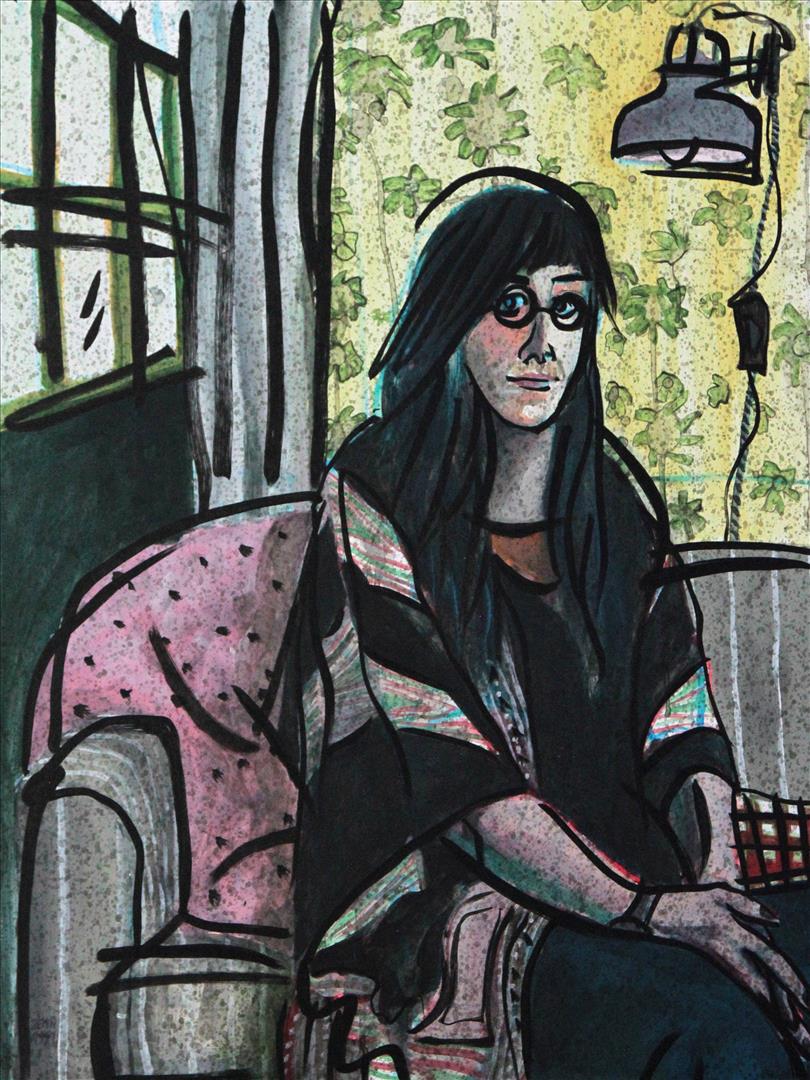
During our building project, the cover of our garden hose reel was lost, so I made a new one. I thought I would paint a river god on it, so I’m calling this chap Vandelius, after our local river the Wandle.
A selection of writing competitions that I might enter, with deadlines in September.
The John McGivering prize is run by the Kipling Society and entries must have some kind of link to Kipling. This year they must also be about food and drink and can be up to 2,500 words long. It costs £8 to enter and you could win £350, but time is short as the deadline is 1 September.
Terrain will take up to 5,000 words: entry is $20 and the top prize $1,000. You have until 2 September.
If you missed last month’s early deadline for Aesthetica, you can still catch the late entry deadline of 8 September, but will pay a little more – £24. The word limit is 2,000 and you can win £2,500
The Royal Society of Literature’s V.S.Pritchett prize is back, with a maximum word count of 4,000. It costs £8 to enter and the top prize is £1,000. Enter by 13 September.
Ink of Ages is looking for historical or mythological stories (no time machines, please). The word limit is 2,000: it’s free to enter and there’s no cash prize but the winner will get a whole lot of stuff apart from seeing the story published. They will send a consignment of books and various items or merchandise, and they will also produce for you a custom piece of art which might be a map, a family tree, or some other graphic. Enter by 15 September.
The Dinesh Alirajah contest this year is on the theme ‘The Unspoken’. Again, it’s free. Stories must be between 2,000 and 7,500 words and you can win £500. The deadline is 22 September.
All the rest have a deadline of 30 September.
Louise Walters is again running her quirky ‘Page 100’ contest in which you submit exactly that page from your manuscript. It costs £10 and you win a book club subscription plus some extra feedback on your work.
Hammond House has the theme ‘Time’ this year. 1,000 to 5,000 words, £10 to enter, and a prize of £1,000 (plus a mention on the local arts TV channel and a place of honour in the annual anthology).
The regular Henshaw contest, now run by Hobeck Books, looks for up to 2,000 words. £6 to enter and £200 to be won.
Christmas already? Crowvus have launched their annual Christmas Ghost story competition. Up to 4,000 words, £3 to enter, win £100.
The Iowa and John Simmons competition is for a collection of short stories running to at least 150 pages. It’s free, but there’s no prize beside publication.
Maybe you prefer money? Also for a collection, Juniper wants 55,000 to 75,000 words. $30 to enter and a prize of $1,000
What to do about the Royal Academy Summer Exhibition? Every year members may exhibit up to three works, but there is also an open competition to which anyone can submit a work, and this is the part that captures the public imagination (my late father submitted a couple of his surreal paintings, without success). Most of the pieces are for sale, at prices ranging from less than £250 up to tens of thousands or more. The result is a wildly varied ragbag of every kind of art from the cornily lowbrow to the most opaquely avant garde, and from works of peerless skill to casual daubs. Quite a few of the works on display are jokey or entertaining novelties. The Academy likes to show as many as it can, so some small pictures are left way up the gallery wall where they cannot be seen properly. It’s all sort of fun, but it isn’t coherent or representative and not much is memorable.
No information about the artists is given beyond their name, and if I were in charge, this is what I would change. I would give a picture and short bio of each artist beside their work. This year’s pieces would be low on the wall, with the opportunity to show others by the same artist directly above, with each vertical space reserved for one artist. I think a little context like this would make the whole thing more interesting.
That would mean fewer artists on the walls, but I would compensate with a big online show, which would also be displayed on screens in one gallery.








 Seen and Done