May 2025 Competitions

Here again are some writing competitions with deadlines during the coming month. The list is not comprehensive (I don’t bother with flash much, for example), but I hope it might be of interest.

  • Folly Journal takes stories between 800 and 2,500 words: NZ$10 to enter and first prize is NZ$1,000 – but the deadline is 1 May, so you need to be quick.
  • F(r)iction is looking for 1,000 to 7,500 words and it’s $10 to enter with a $1,000 prize. The good news is, you’ve got until 2 May. Incidentally, the same publisher is running Dually Noted, where people submit short (500 word) self-contained episodes which can continue the main story arc or be incidental episodes fitting the overall theme, a new addition every week. At the moment the overall theme, which continues until December, is A Night Club for the Newly Departed. No prize except online publication, but it’s free.
  • The Australian Book Review’s Elizabeth Jolley prize looks for up to 5,000 words. AU$30 to enter, a nice $5,000 prize, and the deadline is 5 May.
  • Old stalwart Writer’s Digest is back with a word limit of 4,000, a fee of $30 and a $5,000 prize. Enter by 5 May.
  • Ironclad want stories on the theme ‘Planted’. Up to 6,000 words, it’ll cost you £9 and you can win a comparatively unexciting £100. The deadline is 10 May.
  • Lush Triumphant offers a prize of $1,000 for stories up to 3,000 for a fee of $30 – deadline 15 May. I entered one of these a couple of years ago and could never seem to find out who won.
  • Ploughshares wants up to 6,000. The competition is free to subscribers, or you can pay $30 to enter (for which you also get a year’s subscription – see what they did there?). Enterr by 15 May.
  • The Ghost Story wants – well, have a wild guess – of up to 10,000 words. $20 entry gets you a chance at a $1,500 prize. Deadline 30 May.

All the rest have a deadline of 31 May.

  • The lively Frome Festival wants between 1,200 and 2,000 words: it’s £8 to enter and the top prize is £625.
  • You do not want to miss the prestigious Bridport competition. £5,000 for 5,000 words, with entry £14. This year a new Never Too Late prize will be awarded to the best entrant across all categories who is over 60 (discreet cough).
  • The Goldfinch Novel competition wants your first 3,000 words, plus a synopsis. £10 entry, and the winner gets £500.
  • Yeovil’s short story competition is for stories up to 2,000 words, entry £10.50 and the prize £625. It seems they don’t believe in round figures.
  • The Blue Pencil Agency First Novel competition asks for your first 5,000 words plus a 300-word synopsis. It’s £25 to enter and the prize is £1,000, but if you place you also get an introduction to one of their literary agents: I suppose you finally get to use that elevator pitch.
  • Finally I really have to mention the Robert Traver Fly Fishing Writing Award. (J.R. Hartley! Thou shouldst be living at this hour.) The word limit is 3,000, the fee $25 and the prize $2,500. Judges will look for three key things in the writing: the joy of fly-fishing (personal and philosophic experience); ecology (knowledge and protection of the natural world); and humour (piscatorial friendships and fun on the water). Apparently this has been going on since 2019, and long may it continue.

If you enter any of these and get anywhere, do let me know!
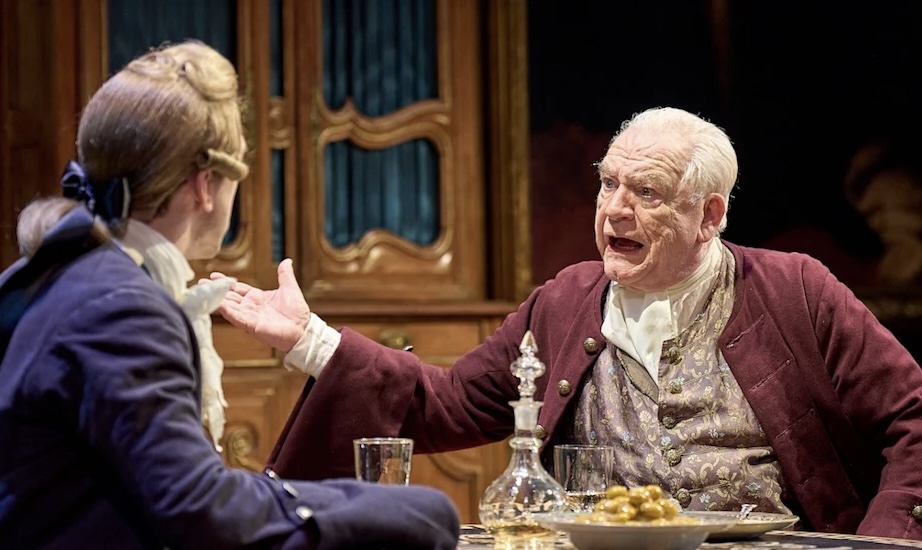
The Score

Brian Cox gives a masterly performance as J.S.Bach in The Score at the Theatre Royal Haymarket (whose opulent interior provides a suitably baroque background). The play, by Oliver Cotton and directed by Trevor Nunn, centres on the true story of Bach’s visit to the court of Frederick the Great, where he was challenged to improvise a three-part fugue on an ‘unfuguable’ theme – which he did, a feat of mental musicianship that seems hardly credible.

Here though, Bach rather implausibly uses the opportunity to denounce Frederick’s military ‘interventions’ and the horrors they bring with them. The King is portrayed as a precursor of later German belligerence, but Bach’s musical insights reveal the complexes that motivate him, rooted in an unhappy childhood. The play is neatly constructed and works pretty well apart from sometimes getting just a little bogged down.

The weakest part, in my view, is Voltaire, who appears as a secondary character but is written, not as the sharp and witty sceptic we know, but as a over-demonstrative French stereotype. He is allowed only one characteristic witticism (‘murderers are severely punished, unless they kill thousands, to the sound of trumpets’). If Voltaire had written this play it would have been shorter and funnier, but that’s a tough benchmark, and Cox’s bravura turn helps make it a well-spent evening.

Visible Darning

This old sweater had been attacked by moths: I thought I would have a go at visible darning, where you make feature of the hole repair. Experts produce works of art, but I just went for traditional square darns with coloured threads for a slight tartan effect. I don’t think I will actually wear this much, but it was an interesting thing to do.