Eyelands
November 28, 2022
My collection of short stories ‘A Book of Goodbyes’ has reached the finals of the Eyelands Awards!
Update: I did not win. But they put my picture and bio up (if you scroll down far enough)
I'm a retired civil servant in Surrey, UK and long-time blogger. These days I'm spending more time writing stories and doing other creative stuff
My collection of short stories ‘A Book of Goodbyes’ has reached the finals of the Eyelands Awards!
Update: I did not win. But they put my picture and bio up (if you scroll down far enough)

Here are the writing competitions I might enter with deadlines in December. I haven’t found all that many this month, especially British competitions. Most of these are American ones, but I believe they are all open to international entries.
The last three all have a deadline of 31 December.
Let me know if you succeed with any of these, and Merry Christmas!
My story ‘A Voice Across the Coughing Brine’ has reached the Dillydoun Review long list!
The title is a quote from a Mervyn Peake poem…
A voice across the coughing brine
Has sewn your spirit into mine!
O love it is for me to die
Upon your bosom noisily,
Ah pity me, ah pity me,
What is it all about?
What is it all about?


We went to see The Crucible at the Olivier. It’s a great production, with strong performances from all the cast. The stage was surrounded by a sheet of artificial rain which was used like a curtain – I’m not really sure why. Very effective use was made of the deeper part of the stage, which would occasionally be lit to show a little scene, someone approaching, or the accusing girls in niches like saints.
What did strike me was that although it is unquestionably deserving of its place as a classic drama, the play would get some criticism if presented to a modern writer’s workshop. It opens with a big slab of straightforward exposition, just spoken direct to the audience: all of that would probably be deleted by a current editor. One of the best episodes in the story is how Giles Corey refuses to plead and chooses to be crushed to death, knowing that this way his estate will pass to his sons, whereas if he were convicted of witchcraft it would be confiscated. Miller throws that away, having it merely described in brief. (He wishes, of course, to focus on John Proctor’s agonising over whether to provide a false confession that will save his life.)
Some of the force of the play is arguably lost because on Miller’s account there really was some witch stuff going on: some of the girls did dance naked, help conjure the dead, and drink (chicken) blood. At the close Tituba and Sarah Good are shown eagerly waiting for the Devil to come and take them. So it seems the authorities are sort of right about the crime, merely pinning the blame on the wrong people.
Finally, things are wrapped up with another slice of exposition – what happened afterwards? It dissipates some of the impact of the deaths, especially Proctor’s, if we go on to hear about remarriages and compensation.
Whatever you think of that, it’s a great play with many memorable passages, and this is a great production.
A selection of writing competitions I might enter during the coming month.
First, a few with deadlines on 1 November.
Then we have a number of competitions with later deadlines.
The rest all have a deadline of 30 November.
If you get somewhere with one of these, let me know!

I went to see the ‘Admonitions of the Instructress to the Court Ladies’ at the British Museum, a Chinese scroll so delicate it is only on display for a few weeks. It may be as old as the fifth century, and the text is from the third. Many of the episodes depict exemplary Empresses: in this picture Lady Feng, the Emperor’s consort, bravely shields the Emperor from an escaped bear, which luckily is killed just in time by two guards, an incident which occurred in 38 BC.
The scroll originally had twelve panels: the first three are lost. There is a twelfth-century drawing which includes the missing bits: unfortunately we can see from comparing the surviving panels that the copy is not totally accurate. It probably gives a good idea of what is missing, but might also be a later reconstruction of panels that were already lost even back then. The depth of history in the thing is breathtaking.
The British Museum bought the scroll from Captain Clarence Johnson, discreetly passing over how he acquired it: it seems clear that in fact he helped himself to it during the Boxer Rebellion.
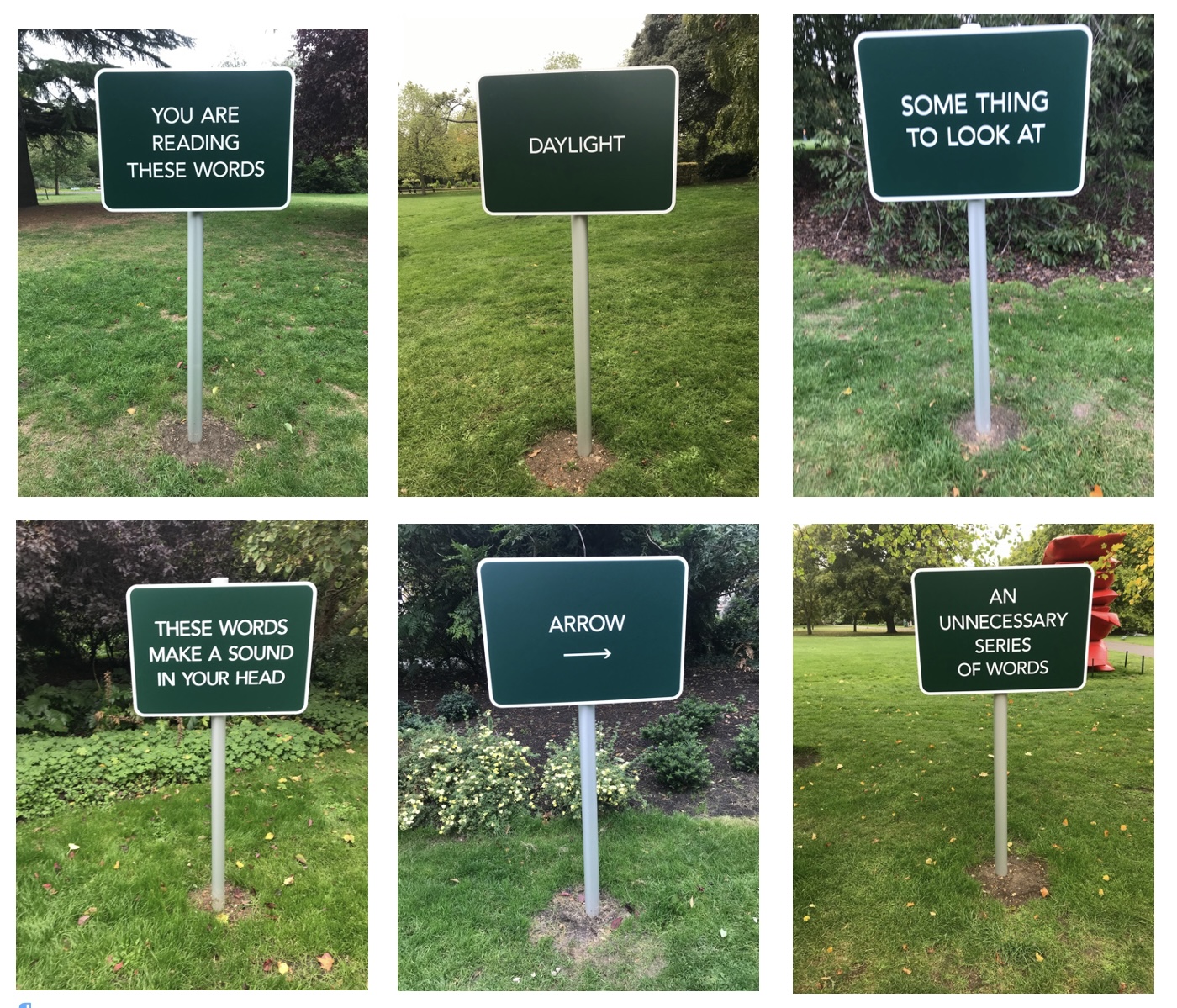
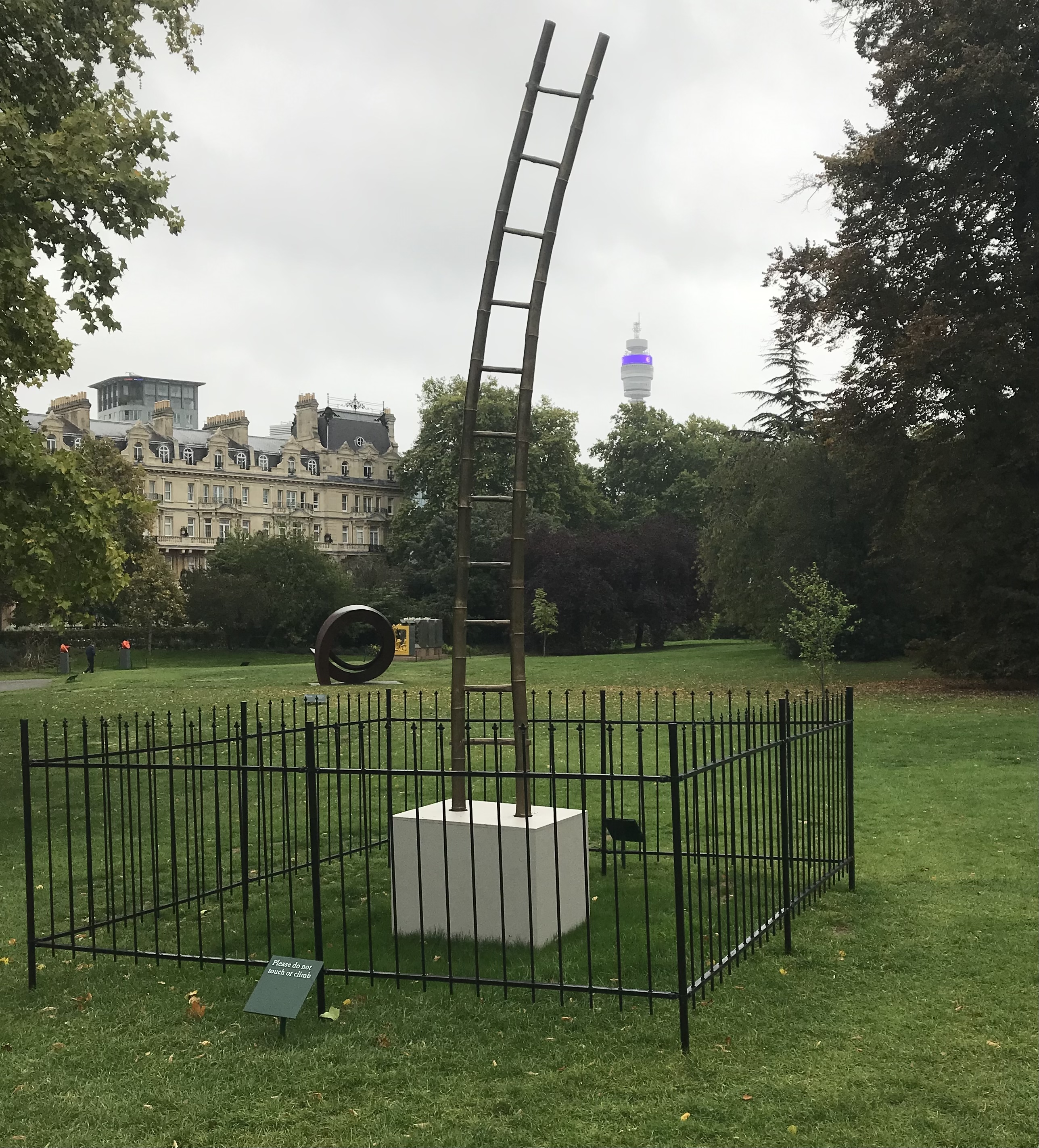
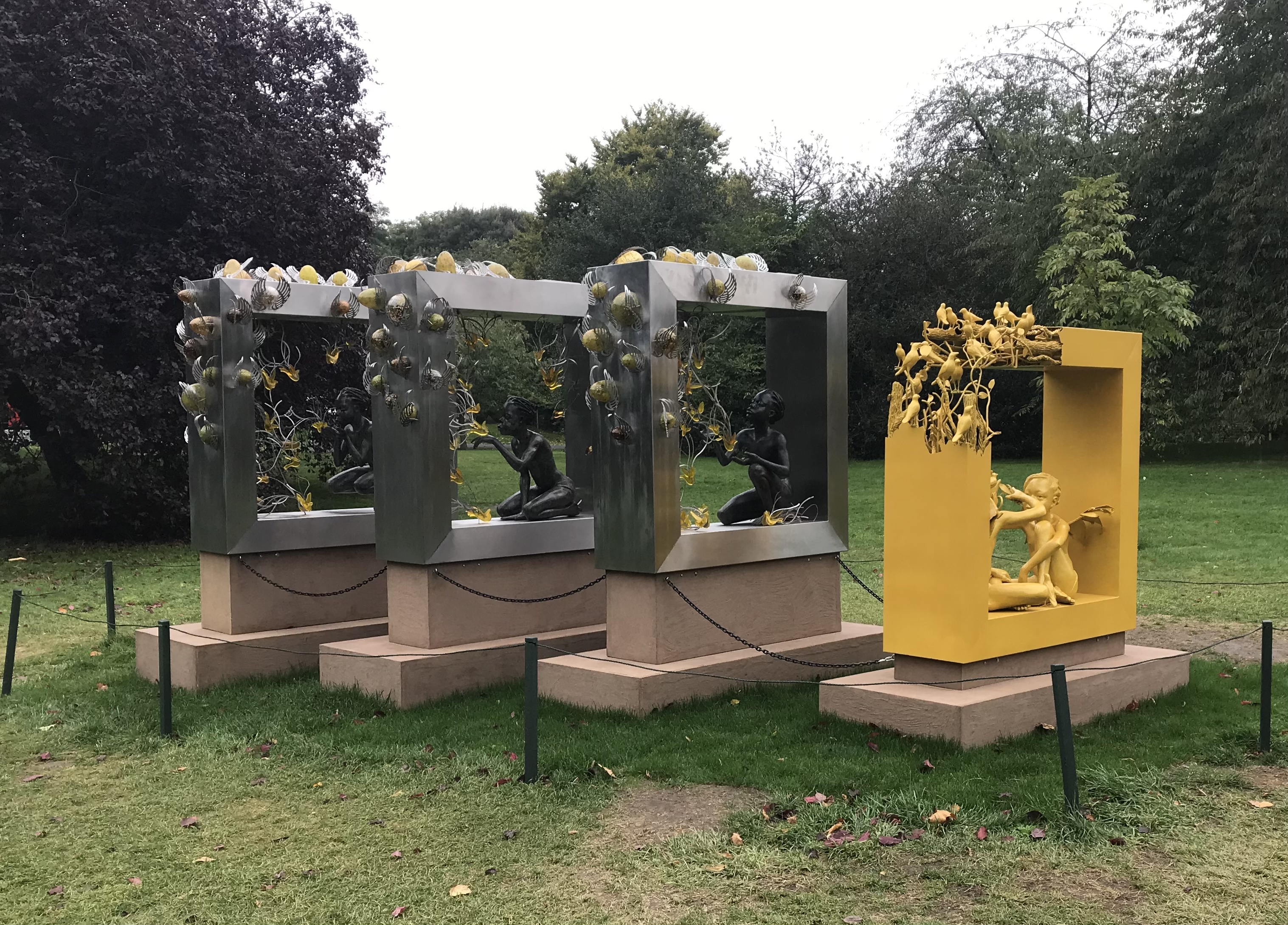
I went to see the sculpture exhibition in Regent’s Park. It’s worth a look: most of the pieces are a bit jokey (in a good way), but Sim and the Yellow Glass Birds is quite poignant. I liked the fake park signs: I wouldn’t be at all surprised to see one on the cover of a philosophical text one day.



We saw a performance of ‘The Rime of the Ancient Mariner’, with selected music by Purcell, at the Queen Elizabeth Hall. Rory Kinnear did an excellent delivery of the poem, while the music came from the Orchestra of the Age of Enlightenment, memorably including a theorbo, a kind of gigantic lute.
In some ways it was an odd combination, as the poem is obviously not contemporary with Purcell. It worked pretty well, though: perhaps it helped that Coleridge’s poem is self-consciously archaic in manner – something that made it an uncomfortable inclusion in the Lyrical Ballads when first published, as that was supposed to demonstrate poetry in ordinary language. The content of the Rime doesn’t really bear much examination, but it is full of powerful images and phrases, which explains its enduring popularity.

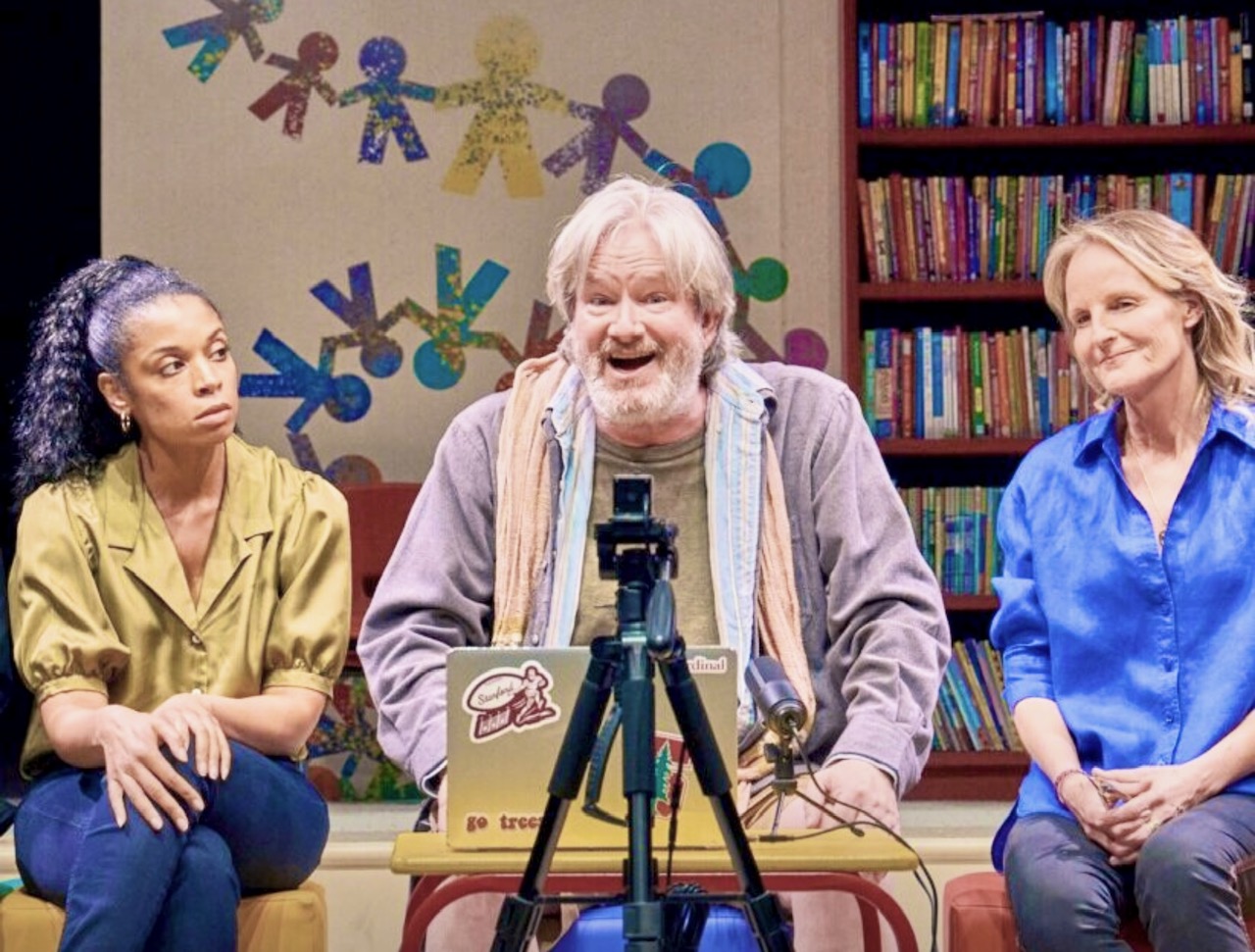
We went to see ‘Eureka Day’ at the Old Vic. Originally produced in 2018 in the USA, it’s about a very progressive, liberal community in Berkeley attached to a school coping (or not) with an outbreak of mumps and conflicts over vaccination. Those issues have gained extra relevance since, of course. The first half is very funny, with a lot of affectionate but sharp parody of how ‘right-thinking’ people get tangled up in discussions of such matters as whether to add an entry to a drop-down menu on ethnicity to cover ‘trans-ethnic adoptee’, and an online discussion that goes badly wrong. I think many Guardian-reading members of the audience enjoyed recognising themselves and their friends (though there were gasps of horror when anti-vax points were made).
The second half gets more serious, as we hear of children seriously ill and worse. Things perhaps get a bit schematic here, with things happening to people in order to provide clear motives for their views. But it’s pretty fair (as poor Don, who keeps trying to lead discussion in positive directions says, ‘nobody in this room is a villain!’) and it remains both engaging and amusing as well as setting out the issues. Lots of nice little touches.
The cast, including Helen Hunt and Mark McKinney, are very good, and I recommend it.
Here’s an experiment – me reading one of my stories on YouTube…
 Seen and Done