My story ‘A Voice Across the Coughing Brine’ has reached the Dillydoun Review long list!
The title is a quote from a Mervyn Peake poem…
A voice across the coughing brine
Has sewn your spirit into mine!
O love it is for me to die
Upon your bosom noisily,
Ah pity me, ah pity me,
What is it all about?
What is it all about?
We went to see The Crucible at the Olivier. It’s a great production, with strong performances from all the cast. The stage was surrounded by a sheet of artificial rain which was used like a curtain – I’m not really sure why. Very effective use was made of the deeper part of the stage, which would occasionally be lit to show a little scene, someone approaching, or the accusing girls in niches like saints.
What did strike me was that although it is unquestionably deserving of its place as a classic drama, the play would get some criticism if presented to a modern writer’s workshop. It opens with a big slab of straightforward exposition, just spoken direct to the audience: all of that would probably be deleted by a current editor. One of the best episodes in the story is how Giles Corey refuses to plead and chooses to be crushed to death, knowing that this way his estate will pass to his sons, whereas if he were convicted of witchcraft it would be confiscated. Miller throws that away, having it merely described in brief. (He wishes, of course, to focus on John Proctor’s agonising over whether to provide a false confession that will save his life.)
Some of the force of the play is arguably lost because on Miller’s account there really was some witch stuff going on: some of the girls did dance naked, help conjure the dead, and drink (chicken) blood. At the close Tituba and Sarah Good are shown eagerly waiting for the Devil to come and take them. So it seems the authorities are sort of right about the crime, merely pinning the blame on the wrong people.
Finally, things are wrapped up with another slice of exposition – what happened afterwards? It dissipates some of the impact of the deaths, especially Proctor’s, if we go on to hear about remarriages and compensation.
Whatever you think of that, it’s a great play with many memorable passages, and this is a great production.
A selection of writing competitions I might enter during the coming month.
First, a few with deadlines on 1 November.
Globe Soup’s historical fiction challenge is interesting. £12 buys you a ticket, the colour of which determines the period in which the story (up to 4,000 words) must be set. Top prize is £1,000. Got my entry in already!
The Caledonia Novel Award is back. They want twenty pages of your novel plus a synopsis. Entry is £25 and you could win £1,500.
The. Commonwealth Short Story prize is free to enter, but offers £2,500 for regional winners and a grand prize of £5,000. You must be a citizen of a Commonwealth country: entries may be in English or in Bengali, Chinese, French, Greek, Kiswahili, Malay, Portuguese, Samoan, Tamil or Turkish.
F(r)iction magazine wants stories between 1,001 (not 1,000, please!) and 7,500 words: it costs $15 to enter and top prize is $1,000.
For the Nilsen First Novel prize, you need to send your complete ms. It’s $25 to enter and the prize is $2,000. Novellas and collections of linked short stories can also be entered.
The John Steinbeck Award from Reed magazine wants stories up to 5,000 words: for an entry fee of $20 you could win $1,000.
Then we have a number of competitions with later deadlines.
The current Liar’s League contest closes on 6 November and is free to enter. Winning stories will be read by an actor in the Phoenix pub, where the author will get free beer all night (this is the London event – I believe there are similar ones in other cities). Ken Towl, my esteemed colleague in a couple of writing groups, has won this three times, but is selflessly keen to encourage more competitors to have a go. This time round stories should be festive and on the theme of ‘hopes and fears’.
The Writer magazine wants up to 2,000 words: entry is $30, top prize $1,000 and the closing date is 8 November.
The Neilma Sidney prize allows up to 3,000 words on the subject of travel. Entry is $12 and first prize $5,000 (Australian dollars, I presume). The deadline is 14 November.
A Smokelong is a story of 1,500 words, just a bit longer than flash: however, the Smokelong Quarterly currently wants flash stories (no more than 1,000 words). Entry fees are a bit complex, but it’s basically $14: top prize is $2,500 and the deadline is 15 November.
The Barry Hannah Prize, from the Yalobusha Review, has an entry fee of $5 and a prize of $500. Entries can be up to 4,000 words and must be on the theme ‘Departures and Arrivals’: they want fiction that pushes the boundaries or is experimental in content or form. The deadline is 18 November.
Those sturdy folk the Wenlock Olympians are running their event again. £5 to enter, a prize of £150, up to 2,500 words, and a deadline of 23 November.
The rest all have a deadline of 30 November.
Banbury Writer’s Café want up to 1,500 words (a smokelong?): it’s free to enter and you could win £50. Entries must be inspired by one of the picture prompts they provide.
The Plaza Prizes actually specify that they want smokelongs. £14 for your first entry then £7 for extra goes: the prize is £1,000.
While we’re going short, let’s go really micro with Doug Weller’s Six Word Wonder contest. Free to enter, the form encourages multiple attempts, and you can win $100. Six words, no fee, win $100.
Finally, I’m dreaming of a green Christmas. The EcoSanta contest wants tales (1000 words) of St Nick going ecological. £5 to enter, win £100.
If you get somewhere with one of these, let me know!
I went to see the ‘Admonitions of the Instructress to the Court Ladies’ at the British Museum, a Chinese scroll so delicate it is only on display for a few weeks. It may be as old as the fifth century, and the text is from the third. Many of the episodes depict exemplary Empresses: in this picture Lady Feng, the Emperor’s consort, bravely shields the Emperor from an escaped bear, which luckily is killed just in time by two guards, an incident which occurred in 38 BC.
The scroll originally had twelve panels: the first three are lost. There is a twelfth-century drawing which includes the missing bits: unfortunately we can see from comparing the surviving panels that the copy is not totally accurate. It probably gives a good idea of what is missing, but might also be a later reconstruction of panels that were already lost even back then. The depth of history in the thing is breathtaking.
The British Museum bought the scroll from Captain Clarence Johnson, discreetly passing over how he acquired it: it seems clear that in fact he helped himself to it during the Boxer Rebellion.
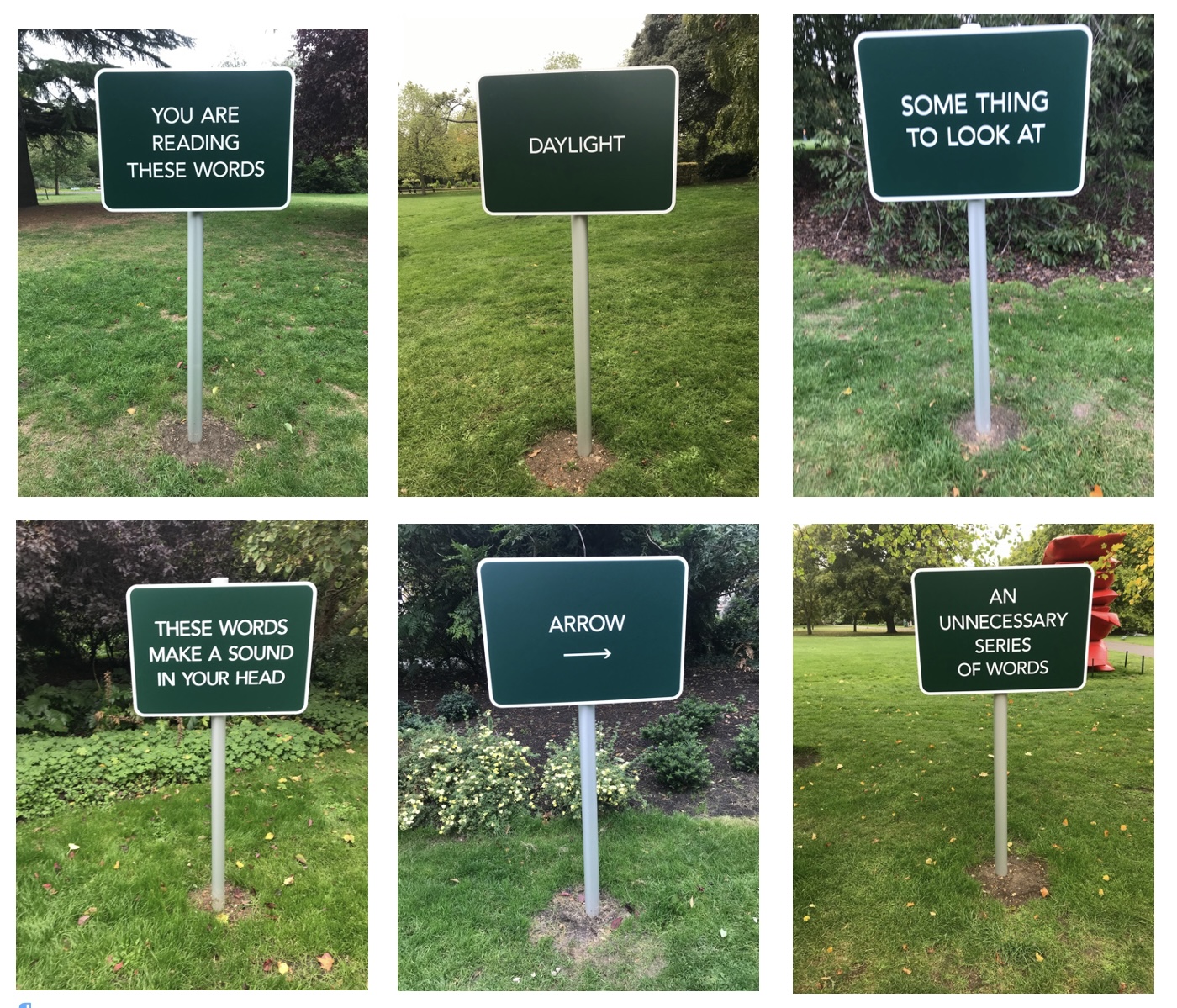
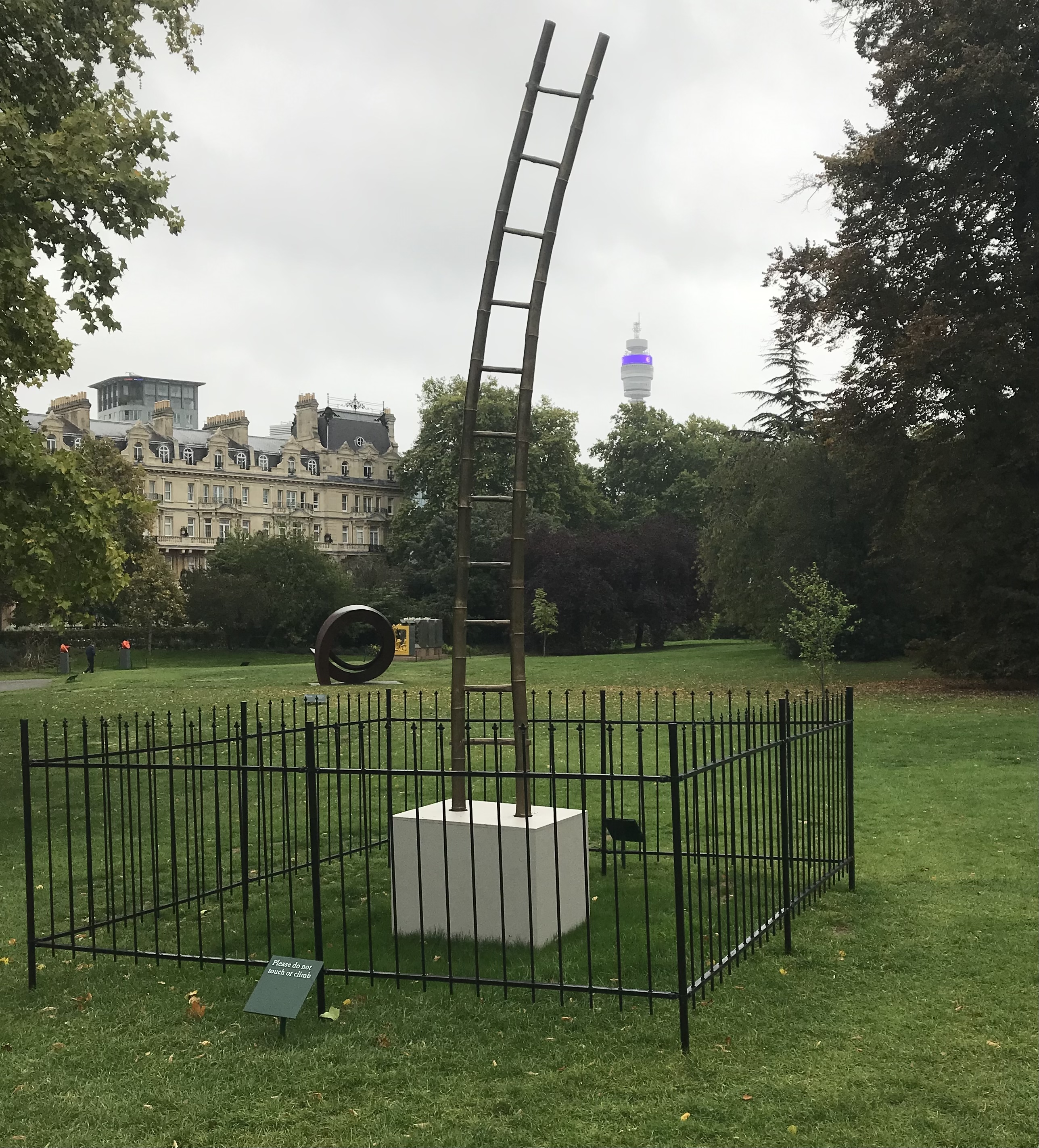
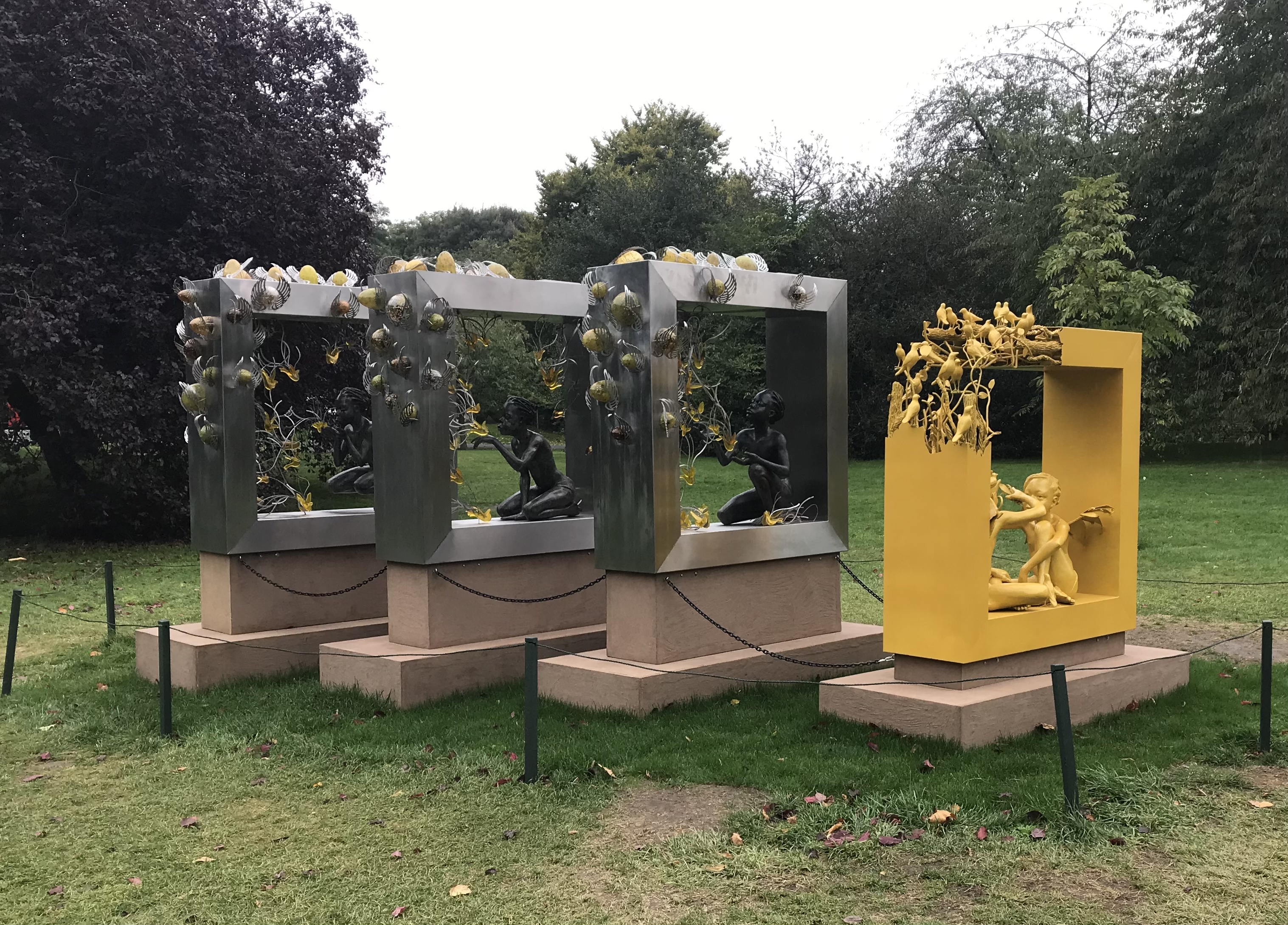
I went to see the sculpture exhibition in Regent’s Park. It’s worth a look: most of the pieces are a bit jokey (in a good way), but Sim and the Yellow Glass Birds is quite poignant. I liked the fake park signs: I wouldn’t be at all surprised to see one on the cover of a philosophical text one day.
We saw a performance of ‘The Rime of the Ancient Mariner’, with selected music by Purcell, at the Queen Elizabeth Hall. Rory Kinnear did an excellent delivery of the poem, while the music came from the Orchestra of the Age of Enlightenment, memorably including a theorbo, a kind of gigantic lute.
In some ways it was an odd combination, as the poem is obviously not contemporary with Purcell. It worked pretty well, though: perhaps it helped that Coleridge’s poem is self-consciously archaic in manner – something that made it an uncomfortable inclusion in the Lyrical Ballads when first published, as that was supposed to demonstrate poetry in ordinary language. The content of the Rime doesn’t really bear much examination, but it is full of powerful images and phrases, which explains its enduring popularity.
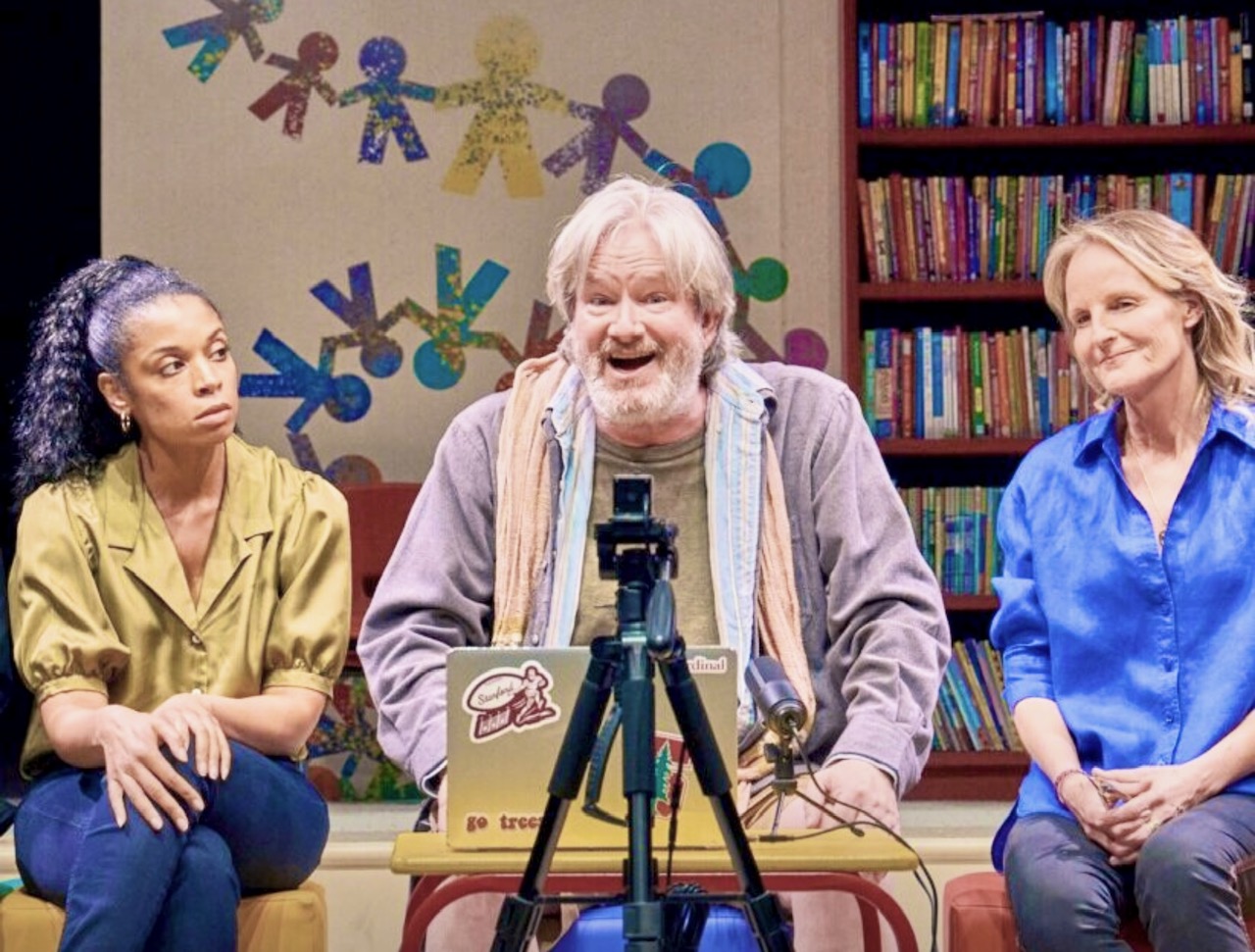
We went to see ‘Eureka Day’ at the Old Vic. Originally produced in 2018 in the USA, it’s about a very progressive, liberal community in Berkeley attached to a school coping (or not) with an outbreak of mumps and conflicts over vaccination. Those issues have gained extra relevance since, of course. The first half is very funny, with a lot of affectionate but sharp parody of how ‘right-thinking’ people get tangled up in discussions of such matters as whether to add an entry to a drop-down menu on ethnicity to cover ‘trans-ethnic adoptee’, and an online discussion that goes badly wrong. I think many Guardian-reading members of the audience enjoyed recognising themselves and their friends (though there were gasps of horror when anti-vax points were made).
The second half gets more serious, as we hear of children seriously ill and worse. Things perhaps get a bit schematic here, with things happening to people in order to provide clear motives for their views. But it’s pretty fair (as poor Don, who keeps trying to lead discussion in positive directions says, ‘nobody in this room is a villain!’) and it remains both engaging and amusing as well as setting out the issues. Lots of nice little touches.
The cast, including Helen Hunt and Mark McKinney, are very good, and I recommend it.
Here are the writing competitions I might enter with deadlines in October.
The American Literary Review wants stories up to a generous 8,000 words. Entry is $15 and the top prize is $1,000. Deadline 1 October.
The Tennessee Williams and New Orleans Literary Festival has a word limit which is only slightly lower at 7,000, and their deadline is the same.. Besides $1,500, the top prize includes a pass to the festival with accommodation and air fare within the USA. Entry is $25.
Dillydoun will also accept up to 8,000 words, and entry is again $25, but their top prize is a full $5,000. The contest closes on 2 October.
With Zoetrope we’re down to the still-generous limit of 5,000 words. Entry is $30, top prize $1,000 and the deadline is 11 October.
You have a bit more time to polish your entry for the Calvino prize, for stories in the magic realist spirit of Italo Calvino (and if you haven’t read him, you really should). Entries can be up to 25 pages long, it’s $25 to enter and you could win $3,000. Oh, and the deadline is 15 October.
At last a British competition, from Galley Beggar Press, with a maximum word count of 6,000, an entry fee of £10, and first prize of £2,500. Deadline 16 October.
Omnidawn want longer pieces: between 7,500 and 17,500 words: they must be fabulist in character. Entry is $18 and the top prize is $1,000: the deadline is 17 October.
The Eyelands prize has several categories, including collections of prose or poetry up to 250 pages long. Winners get a week in Athens and a specially-made ceramic. Entry is €22 and the deadline is 20 October.
Creative Mind is an organisation that has apparently been around since the seventies, but this is its first writing competition (its website still has some rough edges too, with posts labelled ‘example blog post’ and bits of lorem ipsum style boilerplate text). Stories of up to 1,500 words must be on the theme ‘travel’: entry is £3 and the prize £50. Deadline 26 October.
Writefluence offers only publication, but then the entry fee is only INR 150 (currently about £1.66). There’s a 3,000 word maximum and the deadline is 30 October.
The rest of the list have a deadline of 31 October (but see below).
The Bedford competition has a limit of 3,000 words, an entry fee of £7.50 and a prize of £1,000.
SaveAs (which always sounds like a discount store to me) wants stories on the theme ‘Myth’. Up to 3,500 words, entry £3, prize £200.
Letter Review wants up to 2,000 words: entry $20, prize $650.
Fiction Factory is back, asking for maximum 3,000 words, with a fee of £7 and a prize of £500.
Sheila-Na-Gig wants literary pieces (A Sheila Na Gig is an obscene carving of a woman, often found on early medieval churches. Probably not a clue to what you should write about, though.), up to 5,000 words, entry $3, prize $100
Southport Writer’s Circle want up to 2,000 words, entry £3, prize £200
Finally a special mention for Globe Soup’s Historical Fiction Challenge.. To enter you buy a ticket of your chosen colour – this determines the period in which your story must be set (it doesn’t need to be historical in any stronger sense). You can try more than one colour and some hardy souls have bought them all. 4,000 words, entry fee £12 (£2.50 or £15 if early or late): prize £1,000, deadline 28 October. I single it out because Globe Soup is constantly running writing challenges and contests, many free, on its two Facebook sites (one completely free, the other for those who have entered a paid competition). They have a lively and supportive community going where you can always get feedback and advice, and it’s well worth checking out.
If you get somewhere with any of the contests above, do let me know!
We went to see Ian McEwan talk about his new book ‘Lessons’. Quite interesting. At one point, talking about the appeal of music he spoke of ’the relief from meaning’ – unexpected from a novelist! Just need to read the book now.







 Seen and Done