Here We Are

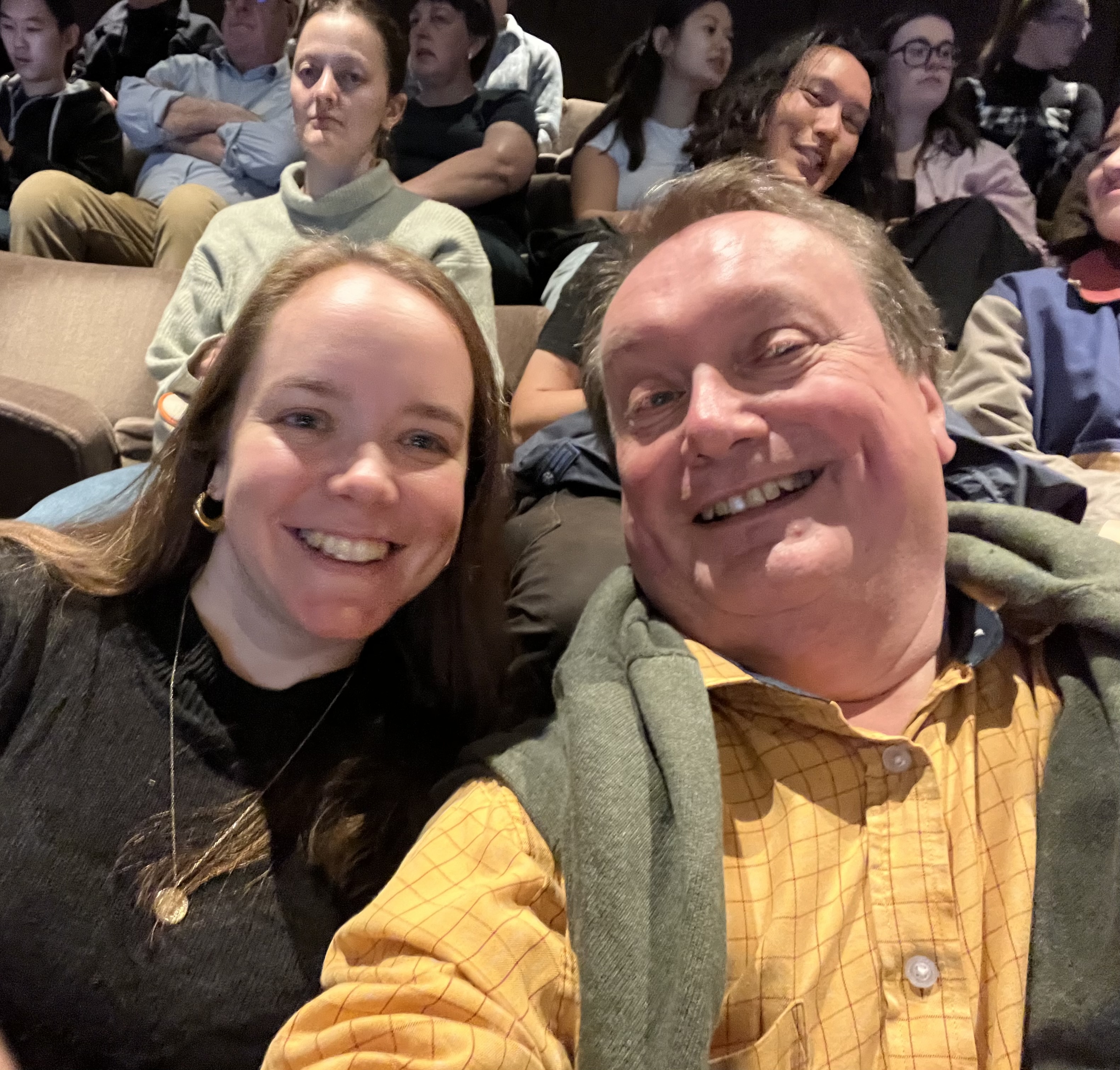
Went with Elizabeth (thanks to her) to see Sondheim’s last work Here We Are, currently at the National Theatre. For Sondheim’s many fans, this last musical, left in draft form at his death, is a must-see, but it’s an entertaining evening for anyone.

It’s based on two Bunuel films: The Discreet Charm of the Bourgeoisie and The Exterminating Angel, but transplanted to America and infused with a New York sense of humour. In the first part the characters just can’t seem to get brunch: in the second they somehow cannot leave the room. Meanwhile they are covertly involved in a drug cartel and a revolution is brewing.

Bunuel’s originals, though surreal, had a dream-like logic which is missing here, but in compensation you get the wisecracking humour. You don’t expect to come out of a late Sondheim show humming the big melodies, but if you’re not a grouch you’ll enjoy the singing.

To me Sondheim represents the pinnacle of the curious trend that briefly saw the Broadway musical turn away from its song-and-dance razzle-dazzle roots towards something much more intellectual. That all stopped when Andrew Lloyd Webber put strong stories and popular tunes back in place, but we were left with some interesting works – and this is a decent final addition to the portfolio.

June 2025 Competitions

Another look at forthcoming writing competitions I might enter. A lot of them have deadlines at the end of the month this time.

  • The Salamander Prize is for stories up to 7,500 words. Entry is $20, top prize $1,000 and the deadline is 1 June.
  • The Halifax Ranch award is for pieces between 2,000 and 6,500 words: $20 entry and a decent $2,500 prize. Deadline 1 June.
  • The Writer’s Digest has a word limit of 4,000. Entry is $35 and the top prize is $1000 – awarded in several categories with lots of lesser prizes. The grand overall winner gets $5,000. The deadline is 3 June.
  • Write by the Sea looks for up to 2,500 words, entry is €10 and the winner gets €500 plus a weekend pass to the festival in the delightful Irish town of Kilmore Quay. You’ve got until 6 June.
  • The MTP prize has a deadline of 10 June, and a word limit of 3,000. £9 to enter and £1,000 prize plus publication for top entries in a chunky anthology. MTP sells publishing services but based on my experience, you will not be pressured to buy them.
  • The Uncharted competition is for novel extracts of up to 5,000 words. $20 entry and a prize of $3,000. The deadline is 15 June.
  • Chaotic Creators want up to 2,000 words. £10 to enter gets you a chance of winning a rather paltry £50.00. The deadline is 23 June.

All the rest have a deadline of 30 June.

  • The Moth is back, looking for up to 3,000 words: entry is £15 and first prize £3,000.
  • The Wells Festival of Literature looks for up to 2,000 words: entry is £6 and the prize is £750.
  • The old faithful Henshaw competition, now run by Hobeck Books, has a maximum word count of up to 2,000, entry £6 and top prize £200.
  • The Katherine Anne Porter competition is for collections of stories totalling between 27,500 and 50,000 words. $25 entry and a prize of $1,000 plus publication.
  • Now one that isn’t fiction – the Writers’ College invites amusing essays of up to 600 words on the theme of ‘The Worst Writing Mistake I’ve Ever Made’. Perhaps I’ll tell them about the entry I sent to the Costa Coffee awards that had the characters meet in Starbucks. This one is free to enter and there’s a prize of NZ$200.
  • WriteTime is one for the oldies – over 60s, in this case. Only 1,500 words is required, £5 to enter and a £100 prize – a little improved on previous years but still well short of a life-changing sum.
  • The redoubtable Chris Fielden is again running his (now biennial) To Hull and Back competition for a humorous piece (which unusually, can have been published before). Up to 2,500 words: it’s £12 for one entry with reduced rates for additional ones. Besides £1,000, the winner is published in an anthology which has as its cover a picture of them riding a motorbike through Hell – or maybe just Birmingham, because Chris solemnly straps a copy to the front of his own bike and rides it from his home in Bristol to Hull where he is acclaimed by cheering crowds (I imagine).
  • Hysteria look for up to 1,000 words: £5 gets you a crack at a mere £75, albeit with the promise of publication.
  • I’m not sure I correctly understand the Page Turner competition which seems complex. There are many categories, but for a story I think they want up to 10 pages: entry fees start at £40 (?) but depending on the package you opt for it could be much more. I think the prizes are $1,000 (why the entry fee is in sterling and the prize in US dollars is just one of many unplumbed mysteries).
  • The Hastings Book Festival returns with a free contest looking for 2,500 words and offering a prize of £250.
  • Cranked Anvil has the same word limit, but charges £6 entry and has a prize of £300.
  • The Letter Review seeks stories up to 5,000 words: for a $20 entry, winners (2-4 of them) share a pool of $1,000

Do let me know if you achieve recognition in any of these, but do not try to enter Periscope’s Paired Fiction prize, because they’ve been overwhelmed by entries and are not accepting any more.

Restoration of Anne Boleyn

This figure, a modern carving on a modern house, became a bit of a landmark in Carshalton. It was removed for restoration a long time ago, but today Anne is back!

Why Anne Boleyn? She stands opposite ‘Anne Boleyn’s Well’ by All Saints’ churchyard, but in fact the history is garbled: the well was originally associated with the local Boulogne family, not connected with the Boleyns (or Bullens as they were more prosaically known).

Nice to see her back, though.

May 2025 Competitions

Here again are some writing competitions with deadlines during the coming month. The list is not comprehensive (I don’t bother with flash much, for example), but I hope it might be of interest.

  • Folly Journal takes stories between 800 and 2,500 words: NZ$10 to enter and first prize is NZ$1,000 – but the deadline is 1 May, so you need to be quick.
  • F(r)iction is looking for 1,000 to 7,500 words and it’s $10 to enter with a $1,000 prize. The good news is, you’ve got until 2 May. Incidentally, the same publisher is running Dually Noted, where people submit short (500 word) self-contained episodes which can continue the main story arc or be incidental episodes fitting the overall theme, a new addition every week. At the moment the overall theme, which continues until December, is A Night Club for the Newly Departed. No prize except online publication, but it’s free.
  • The Australian Book Review’s Elizabeth Jolley prize looks for up to 5,000 words. AU$30 to enter, a nice $5,000 prize, and the deadline is 5 May.
  • Old stalwart Writer’s Digest is back with a word limit of 4,000, a fee of $30 and a $5,000 prize. Enter by 5 May.
  • Ironclad want stories on the theme ‘Planted’. Up to 6,000 words, it’ll cost you £9 and you can win a comparatively unexciting £100. The deadline is 10 May.
  • Lush Triumphant offers a prize of $1,000 for stories up to 3,000 for a fee of $30 – deadline 15 May. I entered one of these a couple of years ago and could never seem to find out who won.
  • Ploughshares wants up to 6,000. The competition is free to subscribers, or you can pay $30 to enter (for which you also get a year’s subscription – see what they did there?). Enterr by 15 May.
  • The Ghost Story wants – well, have a wild guess – of up to 10,000 words. $20 entry gets you a chance at a $1,500 prize. Deadline 30 May.

All the rest have a deadline of 31 May.

  • The lively Frome Festival wants between 1,200 and 2,000 words: it’s £8 to enter and the top prize is £625.
  • You do not want to miss the prestigious Bridport competition. £5,000 for 5,000 words, with entry £14. This year a new Never Too Late prize will be awarded to the best entrant across all categories who is over 60 (discreet cough).
  • The Goldfinch Novel competition wants your first 3,000 words, plus a synopsis. £10 entry, and the winner gets £500.
  • Yeovil’s short story competition is for stories up to 2,000 words, entry £10.50 and the prize £625. It seems they don’t believe in round figures.
  • The Blue Pencil Agency First Novel competition asks for your first 5,000 words plus a 300-word synopsis. It’s £25 to enter and the prize is £1,000, but if you place you also get an introduction to one of their literary agents: I suppose you finally get to use that elevator pitch.
  • Finally I really have to mention the Robert Traver Fly Fishing Writing Award. (J.R. Hartley! Thou shouldst be living at this hour.) The word limit is 3,000, the fee $25 and the prize $2,500. Judges will look for three key things in the writing: the joy of fly-fishing (personal and philosophic experience); ecology (knowledge and protection of the natural world); and humour (piscatorial friendships and fun on the water). Apparently this has been going on since 2019, and long may it continue.

If you enter any of these and get anywhere, do let me know!

The Score

Brian Cox gives a masterly performance as J.S.Bach in The Score at the Theatre Royal Haymarket (whose opulent interior provides a suitably baroque background). The play, by Oliver Cotton and directed by Trevor Nunn, centres on the true story of Bach’s visit to the court of Frederick the Great, where he was challenged to improvise a three-part fugue on an ‘unfuguable’ theme – which he did, a feat of mental musicianship that seems hardly credible.

Here though, Bach rather implausibly uses the opportunity to denounce Frederick’s military ‘interventions’ and the horrors they bring with them. The King is portrayed as a precursor of later German belligerence, but Bach’s musical insights reveal the complexes that motivate him, rooted in an unhappy childhood. The play is neatly constructed and works pretty well apart from sometimes getting just a little bogged down.

The weakest part, in my view, is Voltaire, who appears as a secondary character but is written, not as the sharp and witty sceptic we know, but as a over-demonstrative French stereotype. He is allowed only one characteristic witticism (‘murderers are severely punished, unless they kill thousands, to the sound of trumpets’). If Voltaire had written this play it would have been shorter and funnier, but that’s a tough benchmark, and Cox’s bravura turn helps make it a well-spent evening.

Visible Darning

This old sweater had been attacked by moths: I thought I would have a go at visible darning, where you make feature of the hole repair. Experts produce works of art, but I just went for traditional square darns with coloured threads for a slight tartan effect. I don’t think I will actually wear this much, but it was an interesting thing to do.

The Seagull

We were lucky enough to get really good tickets at a reasonable price for The Seagull at the Barbican with Cate Blanchett. This is a modern, rather innovative (some might say gimmicky) production by Thomas Ostermeier. Most of the additions, changes and updates are OK, I think. Some, like regularly breaking the fourth wall, are intended to highlight a kind of dialogue about the relation between performance and reality: modern music and references are either irrelevant or legitimately funny. Probably the most uneasy thing imo is the way the character Semyon Medvedenko is changed from a poor schoolteacher into a ‘factory worker’ (how is a factory worker hanging around this country estate all the time?) who drives around on a quad bike and sings Billy Bragg songs – though of course we are made well aware that it is not Medvedenko singing, but the actor Zachary Hart.

The cast is terrific, by the way though obviously Cate Blanchett’s amazing performance as the famous actress (see what they did there) and attention-hogging narcissist Irina Arkadina outshines everything else. The tap-dancing and doing the splits are the least of it, I promise you.

It’s a terrific show, and the fact that it is so clever, funny and profound is largely due to the fact that none of the fancy tricks is ultimately allowed to get in the way of Chekhov’s classic play, which is delivered pretty well intact. I would strongly recommend it, but I think it’s sold out.