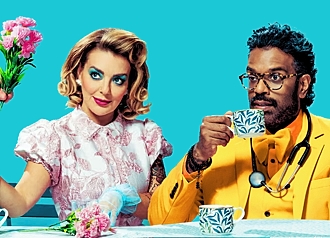
Woman In Mind

We went to see the new production of Woman In Mind, the Alan Ayckbourn classic, staring Sheridan Smith as Susan and with Romesh Ranganathan as Bill Windsor. It’s a great show and I recommend it: funnily enough my only reservations are about the play itself. There are some spoilers in what follows.

The story is in essence about a woman losing her mind. In the early stages her delusional and at first ideal life contrasts with the depressing reality, as she switches between the two. I would have liked a neat resolution to all this, but we don’t get one: instead the delusions get stronger, less controllable and less pleasant and eventually swallow her up.

I said one side of the story is the depressing reality of her life, but in fact our faith in the reality of even the ‘real’ parts is gradually undermined (or at least, mine was). Bill Windsor seems to move across gradually from sensible reality to florid delusion. Muriel the sister-in-law seems like a caricature, too completely awful to be a real person. The behaviour of Susan’s son is not depressing in normal ways but bizarre, and seems to revolve around her, even if in a most negative way. So perhaps in the end we are to realise that the entire play is the record of a set of growing delusions that reflect reality only in a distorted way. That can still be interesting, but I think a little less than a play that does engage with real life effectively.

The Duchess

The Duchess, starring Jodie Whittaker, is an updated version of Webster’s The Duchess of Malfi. As in the original, the widowed young Duchess secretly marries her steward and has children by him, leading to violent intervention from her brothers, one of whom is a cardinal. A bloody second act leaves pretty much everyone horribly dead (this is John Webster, after all).

Good performances and a suitably stark setting, but the update doesn’t work well. The Duchess’s seduction of her steward is played for laughs, which makes it hard to accept later on that this is a passion people will die for. The characters are given a sweary, casual, 21st century manner, which makes their Jacobean behaviour puzzling, and undercuts the horror of the later scenes. Are they just mucking about? The audience laughs at lines they are meant to take seriously, as if the whole thing were a parody or a historical sitcom.

It may be that the intended message is that our patriarchal attitudes are still all too much like those of the seventeenth century: but the play sort of demonstrates the opposite. These people actually seem pretty weird and keep doing things for no reason a modern, egalitarian mind can grasp. I think Webster needs a kind of claustrophobia and deep passion to achieve his impact, and neither is present here, unfortunately.

Not Ian McKellen

We had booked to see Ian McKellen as Falstaff in Player Kings, an abbreviated merging of Shakespeare’s Henry IV parts one and two. Then he fell off the stage and was hurt. At first he hoped to be back on Wednesday, then they said one more day cancelled and he’ll be back on Thursday (our day). On Thursday, they said the performance was going ahead – but with the understudy. Nobody would want Sir Ian to take any chances, but of course it was disappointing.

The understudy was David Semark, and he did a very good job (perhaps being physically a better match for Falstaff). The production was very good. Modernish dress, and for some reason the characters smoked cigarettes. The sword fights, here performed with knives, sat oddly in a battle where guns and high explosive were being used.

The cuts needed to bring two plays down to a manageable single evening had some impact – Hotspur here, deprived of scenes with his wife, lacked charm and seemed merely belligerent: on the other hand for some reason he was depicted as easily defeating Hal, who had to resort to abusing the sporting chances he was given and stabbing his opponent in the back.

Toheeb Jimoh’s reading of Hal gave us an uncertain Prince rather than the steely, cold manipulator which is another reading. This perhaps sat well with the merging of the plays. Shakespeare had to depict Hal’s transformation twice for two audiences, and when you put both together he seems less decisive than he does in either play alone. I thought (and I know you can’t criticise Shakespeare) that the merger also highlighted the redundancy of some minor characters

Some wonderful passages, of course, and an enjoyable evening still.